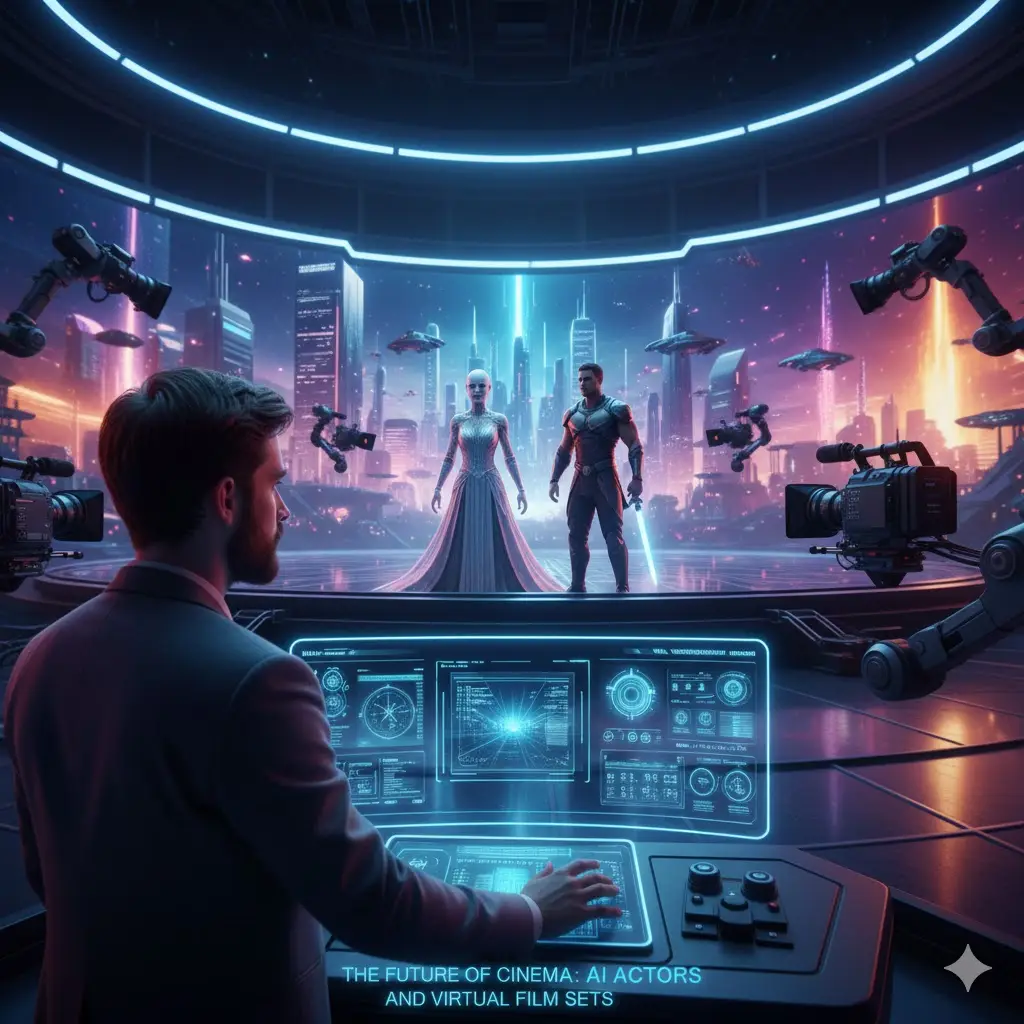

Cinema has always been at the edge of the latest technological changes-from the silent film era through the use of CGI and digital filmmaking. Now, we stand on the doorstep of a new revolution: AI actors and virtual film sets. These innovations are completely changing the way the film industry produces movies. This article will explore some of the ways these technologies are changing films in production, the artistic role of actors, and the entire creative process.
From virtual characters, deepfake technology, and full immersion into digital environments, AI and digital filmmaking are changing not only how stories are told, but by whom and where those stories take place.
Actors in the AI Age: The Changing Role of Performers
The use of AI actors, or digital beings created through artificial intelligence and machine learning, is becoming more mainstream in film. These AI-generated characters can execute complex scenes, put on different human emotions, and even interact with other real actors in seamless fashion. But what, exactly, are AI actors, and how are they being used in cinema?
What are AI actors?
AI actors are virtual beings that come alive through deep learning algorithms, motion capture, and voice synthesis. These characters can imitate human movements, facial expressions, and even speech. Some AI actors are entirely digital, while others might be enhanced versions of real actors, created to perform specific actions or even replace human talent.
A popular example of AI in movies is the character of Leia Organa in Star Wars: Rogue One, 2016. The film used a combination of digital effects, archival footage, and CGI to recreate Carrie Fisher’s iconic role. While by no means an AI-only performance, this early use of digital replication paved the way for deeper integrations of AI actors in films.
Benefits of AI Actors
The inclusion of AI actors provides various benefits in filmmaking, such as:
Cost Efficiency: AI actors do away with long shoots, traveling expenses, and even physical sets.
Creative Freedom: Filmmakers are at liberty to create characters and scenarios in ways that may well be impossible or too expensive to actually film.
Longevity: AI actors can outlive human performers and keep characters alive in movies for generations.
Challenges and Controversies
Despite the many benefits listed above, the use of AI actors raises several ethical concerns: consent, preservation of human jobs, and manipulation of digital likenesses are among the debates. Can AI actors ever replace human performers, or will they always serve as some kind of enhancement?
Virtual Film Sets: Building Worlds Beyond Reality
Virtual film sets are a groundbreaking technology that is changing the way movies are made. Using advanced technologies like Virtual Reality, Augmented Reality, and real-time rendering engines like Unreal Engine, filmmakers can create entire worlds without ever having to leave a studio.
What are virtual film sets?
A virtual film set is a completely digital environment that can re-create any location existing in the physical world, from the busy streets of New York to a fantasy world on an alien planet. Through green screens and the use of motion capture, a filmmaker can place actors within these virtual environments so that the actors appear to be interacting with their surroundings.
One of the most popular examples of virtual sets in recent years is The Mandalorian (2019). The show’s creators decided to try Stagecraft, a virtual set developed by ILM, Industrial Light & Magic, in creating breathtaking visuals without needing to go on location. This gave the filmmakers incredible flexibility and levels of creative control that had previously not been possible.
Advantages of Virtual Film Sets
Cost Savings: It saves costs on location travel and building the sets, as virtual sets negate the need for physical locations.
Flexibility: Filmmakers can change entire scenes or locations in real time without moving cameras or sets.
Environmental Sustainability: Virtual film sets are eco-friendly since they minimize the need for extensive travel and the construction of physical props and locations.
The Technology behind Virtual Sets
The backbone of virtual sets lies in the power of real-time rendering. This is a technology widely used in the gaming industry, whereby filmmakers can visualize complex environments at once. As an example, Unreal Engine provides the tools necessary to create photorealistic settings that can be changed and adjusted on the fly.
AI and Virtual Film Sets in Action: Case Studies
Avengers: Endgame (2019)
Another striking example of AI and virtual filmmaking technology in action is Avengers: Endgame. A lot of the movie was filmed on sets, but it also used a lot of CGI, virtual characters, and motion capture. AI created convincing simulations for characters like digitally aged Tony Stark played by Robert Downey Jr. and the motion-captured Hulk of Mark Ruffalo. The film’s most complicated action sequences, where characters fight in environments fully created by a computer, were possible only because of virtual sets.
The Lion King (2019)
Another example is The Lion King, a 2019 film that could technically be categorized as a CGI-animated film but utilized real-time rendering and motion capture to create ultra-realistic animal characters. Using virtual sets, they could simulate a photorealistic version of the African savanna, blurring the line between animation and reality.
Expert Opinion: The Future of AI and Virtual Sets
John Favreau on Virtual Sets
Director John Favreau, known for helming The Mandalorian and The Lion King, has been a key evangelist for virtual filmmaking. He’s talked at some length about the advantages of virtual sets, citing the greater creative freedom the approach affords and how such environments can be far more immersive. According to Favreau, virtual sets create a “sandbox” where filmmakers can experiment with new ideas without being restricted by the limitations of physical sets or locations.
AI in Acting: The Ethical Dilemma
The implications of AI actors raise concerns among ethicists and actors alike. One is of the view that a surge in AI might halt human involvement in film, mainly for those characters that have little to contribute in terms of emotions or physicality. Others believe that AI actors will become a new tool for telling stories, enabling directors to go beyond human capabilities, for instance, in science fiction or fantasy genres.
Conclusion
The New Era in Cinema The future of cinema is certainly bright. AI actors and virtual film locations are unlocking new avenues for filmmakers, offering creative freedom, cost savings, and technological advancements that will shape the industry for years to come. And as these continue to evolve, it will change not only how films are made but also how they are watched.
While there are challenges that come with ethics, regulation, and the preservation of human artistry, the future for AI and virtual film sets does look bright. These technologies are not about displacing human talent but augmenting it and offering new ways to tell stories, create lifelike characters, and transport viewers into the unimaginable.
Also Read: Reacher Season 4: What to Expect and Everything We Know So Far